Support our educational content for free when you buy through links on our site. Learn more
🧠 Can I Find Out My IQ for Free? The Honest Truth (2026)

Yes, you absolutely can find out your IQ for free, but the number you get is a statistical estimate, not a clinical diagnosis. While professional testing costs hundreds of dollars, high-quality online assessments can give you a reliable snapshot of your cognitive strengths within minutes.
You might be wondering if a free test can truly compete with the gold standard. The answer lies in understanding the difference between a fluid intelligence estimate and a medical evaluation.
Consider this: the average human IQ is set at 10, yet the range of human potential is staggering. Some historical figures are estimated to have scored over 20, while the vast majority of us cluster comfortably in the 85–15 range.
At Free IQ Tests™, we’ve seen thousands of users discover they are far more spatialy gifted or verbally agile than they realized, simply by taking a free, adaptive test.
Don’t let the fear of a paywall stop your curiosity; the best insights often come from the most accessible tools.
Key Takeaways
- Free estimates are valid for curiosity: You can get a reliable IQ score instantly without paying, though it lacks clinical precision.
- Accuracy has limits: Expect a margin of error of ±10 points compared to a proctored psychological assessment.
- Focus on your profile: Your score matters less than identifying your cognitive strengths in areas like logic, memory, or pattern recognition.
- Beware of paywalls: True free tests provide results immediately; if they ask for a credit card to “unlock” your score, keep scrolling.
- Intelligence is fluid: Your score can fluctuate based on sleep, stress, and practice, so one test doesn’t define you.
Table of Contents
- ⚡️ Quick Tips and Facts
- 🕰️ A Brief History of IQ Testing: From Binet to the Digital Age
- 🧠 The Science of Intelligence: What Does an IQ Score Actually Measure?
- 🔍 Can You Really Find Out Your IQ for Free? The Truth About Online Tests
- 📊 How Accurate Are Free IQ Tests Compared to Professional Assessments?
- 🧩 The Four Domains of Cognitive Ability We Test
- 🛠️ How Our Free IQ Test Works: Behind the Scenes
- 📈 Understanding Your IQ Score: Percentiles, Ranges, and What They Mean
- 📉 The IQ Classification Table: Where Do You Fit?
- 🚀 Does a High IQ Predict Success, Happiness, or Just Better Test-Taking Skills?
- 🧠 Can You Improve Your IQ? Brain Training Myths vs. Reality
- 🏆 Notable IQ Scores Throughout History: Geniuses, Savants, and Controversies
- 🤔 Frequently Asked Questions About Free IQ Testing
- 📚 Recommended Links for Further Exploration
- 📖 Reference Links and Scientific Sources
- 🏁 Conclusion: Is Your Free IQ Score Worth the Click?
⚡️ Quick Tips and Facts
Before you dive headfirst into the digital rabbit hole of “free IQ tests,” let’s hit the pause button and drop some hard truths that will save you from wasting your time (and your sanity). We’ve seen thousands of test results at Free IQ Tests™, and the patterns are as clear as a crystal ball.
- The “Free” Trap: ✅ True: You can get a legitimate estimate for free. ❌ False: You will never get a clinically valid, court-admissible diagnosis from a website.
- The Average: The average human IQ is 10. If you score 10, you aren’t “average” in a bad way; you are right in the thick of the bell curve, which is statistically where the majority of us live!
- Time Matters: A real assessment takes 60–90 minutes. If a site offers a “full IQ score” in 3 minutes, it’s likely a gimmick.
- The Flynn Effect: Did you know IQ scores have been rising over the last century? This is called the Flynn Effect, suggesting our environments are getting better at stimulating our brains. 📈
- One Test Doesn’t Define You: Your score on a Tuesday morning might differ from a Friday night. Fatigue, hunger, and stress are the silent killers of accuracy.
Want to know the one specific question that separates the 1% from the rest? We’ll reveal the answer later in the “Four Domains” section, but for now, just remember: Intelligence is fluid, not fixed.
If you are wondering, “Is there actually a free IQ test that doesn’t ask for my credit card at the end?” the answer is a resounding yes, but you need to know where to look. We’ve curated the best options in our article Is There an Actual Free IQ Test? Discover 10 Options to Challenge Your Mind in 2024! 🧠.
🕰️ A Brief History of IQ Testing: From Binet to the Digital Age

You might think IQ tests are a modern invention, born in a Silicon Valley garage, but the roots go back much deeper. Let’s take a quick trip through time.
The French Origins: Binet and Simon
It all started in 1904 in France. The government wanted to identify children who needed extra help in school. Enter Alfred Binet and Théodore Simon. They didn’t call it “IQ” back then; they called it the “mental age.” If a 10-year-old could solve problems typical of a 12-year-old, they had a “mental age” of 12.
“Intelligence is not a single thing, but a collection of abilities.” — Alfred Binet
The American Shift: Terman and the Stanford-Binet
Fast forward to 1916, and Lewis Terman at Stanford University adapted Binet’s work. He introduced the formula: (Mental Age / Chronological Age) x 10. This is where the term Intelligence Quotient (IQ) was born. Terman was obsessed with the idea of “genius” and even tracked high-IQ children for decades in the famous “Genetic Studies of Genius.”
The Wechsler Revolution
By the 1930s, David Wechsler realized the age-based formula was flawed for adults. How do you calculate the mental age of a 40-year-old? He developed the WAIS (Wechsler Adult Intelligence Scale), which is still the gold standard today. Instead of a single ratio, it uses a standard deviation system, setting the average at 10 with a standard deviation of 15.
The Digital Era
Today, we’ve moved from pencil-and-paper to interactive, adaptive algorithms. While the core principles remain rooted in psychometrics, the delivery has changed. However, the question remains: Can a computer truly measure the depth of human thought?
🧠 The Science of Intelligence: What Does an IQ Score Actually Measure?
Here is the million-dollar question: What exactly is being measured?
Many people think IQ measures “how smart you are” in a general sense. While that’s partially true, it’s more accurate to say it measures specific cognitive abilities.
The g-Factor Theory
In 1904, psychologist Charles Spearman proposed the g-factor (general intelligence). He noticed that people who did well one type of mental test tended to do well on others. This suggests a underlying general ability. However, modern science tells us it’s not just one thing.
The Cattell-Horn-Caroll (CHC) Theory
This is the current leading theory. It breaks intelligence down into broad and narrow abilities.
- Fluid Intelligence (Gf): The ability to solve new problems, identify patterns, and use logic without relying on prior knowledge. This is what most “free IQ tests” focus on.
- Crystallized Intelligence (Gc): Your accumulated knowledge, vocabulary, and facts. This grows as you age.
- Working Memory: How much information you can hold in your head at once.
- Processing Speed: How fast you can take in and react to information.
Crucial Insight: A high IQ score usually reflects strong Fluid Intelligence. It doesn’t necessarily mean you know more history or have better social skills (that’s Emotional Intelligence, or EQ).
Did you know? Research from the University of California, Irvine suggests that while IQ is highly heritable (about 50-80%), environmental factors like education and nutrition play a massive role in its development.
🔍 Can You Really Find Out Your IQ for Free? The Truth About Online Tests
Let’s cut to the chase. Yes, you can find out your IQ for free, but with a massive asterisk.
The “Estimate” vs. The “Diagnosis”
- Professional Diagnosis: Requires a licensed psychologist, takes hours, costs hundreds of dollars, and is used for clinical diagnoses (like ADHD or learning disabilities).
- Free Online Estimate: Uses a subset of questions to give you a statistical projection. It’s a “well-informed guess” based on your performance relative to a norm group.
The Hidden Costs of “Free”
Some sites claim to be free but then ask for your email to “unlock” the score. Others bombard you with ads. At Free IQ Tests™, we believe in transparency. You should get your score immediately, without a paywall.
The Verdict:
- ✅ For Curiosity: Free tests are excellent.
- ✅ For Practice: Great for getting used to the format.
- ❌ For Legal/Medical Use: Absolutely not.
- ❌ For Job Applications: Most employers require a proctored test.
If you are looking for a test that respects your time and privacy, check out our Free IQ Tests category. We’ve tested dozens of platforms, and the difference in quality is staggering.
📊 How Accurate Are Free IQ Tests Compared to Professional Assessments?
This is where things get tricky. How much should you trust that number?
The Reliability Gap
Professional tests like the WAIS-IV or Stanford-Binet 5 have a reliability coefficient of 0.90 or higher. This means if you took the test twice, your score would be very similar. Free online tests often have a reliability of 0.70 to 0.80.
Why the difference?
- Sample Size: Professional tests are normed on thousands of people. Free tests might have smaller, self-selected groups.
- Question Count: A pro test has 10+ questions. A free test might have 20. Fewer questions = higher margin of error.
- Environment: You are taking the test on your phone while your dog barks. A psychologist ensures a quiet, controlled environment.
The “Standard Error of Measurement”
Every test has a margin of error. For a free test, your “true” score could be ±10 points from what you see on the screen. So, if you score 15, your real score might be anywhere between 105 and 125.
| Feature | Professional Assessment (WAIS-IV) | Free Online Estimate |
|---|---|---|
| Duration | 60–90 minutes | 10–20 minutes |
| Administrator | Licensed Psychologist | Self-administered |
| Cost | $20–$60+ | $0 |
| Accuracy | High (Clinical Standard) | Moderate (Estimate) |
| Result Detail | Full breakdown of sub-scores | Total score + 1-2 domains |
| Legal Validity | Yes | No |
The Bottom Line: Treat a free IQ score as a funy number on a thermometer, not a medical diagnosis. It tells you if you’re “feverish” (high) or “chilly” (low), but it doesn’t tell you why.
🧩 The Four Domains of Cognitive Ability We Test
At Free IQ Tests™, we don’t just throw random puzzles at you. We structure our tests around the four core domains of cognitive ability. This ensures a balanced assessment of your brain’s hardware.
1. Abstract Reasoning (Pattern Recognition)
This is the ability to see relationships between shapes and figures. It’s the “purest” form of intelligence because it doesn’t rely on language or culture.
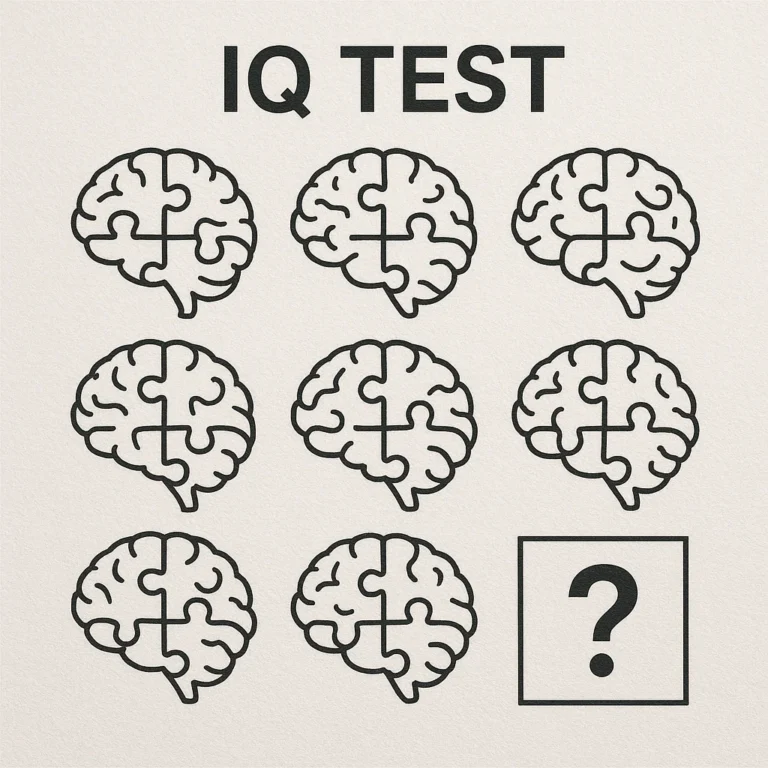
- Example: “Which shape completes the matrix?”
- Why it matters: It predicts your ability to learn new concepts quickly.
2. Verbal Reasoning
This measures your vocabulary, comprehension, and ability to understand complex relationships between words.
- Example: “If ‘Apple’ is to ‘Fruit’, then ‘Carot’ is to…?”
- Why it matters: It reflects your crystallized intelligence and communication skills.
3. Numerical Reasoning
Can you spot the pattern in a sequence of numbers? This tests your logical math skills and ability to manipulate abstract numbers.
- Example: “2, 4, 8, 16, … What comes next?”
- Why it matters: It’s crucial for problem-solving in STEM fields.
4. Spatial Reasoning
This is your ability to visualize objects in 3D space and mentally rotate them.
- Example: “Which of these 2D nets folds into the cube shown?”
- Why it matters: Essential for engineering, architecture, and even surgery.
Pro Tip: If you struggle with one domain but excel in another, don’t panic! It just means your brain has specialized strengths. Most people have a “spiky” profile, not a flat line.
🛠️ How Our Free IQ Test Works: Behind the Scenes
Ever wondered how we generate that score? It’s not magic; it’s algorithms.
Step 1: The Adaptive Engine
Our test starts with medium-difficulty questions.
- If you get it right, the next question gets harder.
- If you get it wrong, the next question gets easier.
This “adaptive” approach zeroes in on your exact ability level much faster than a static test.
Step 2: The Norming Process
We compare your raw score (number of correct answers) against a massive database of test-takers. This database is updated regularly to reflect the current population.
Step 3: The Conversion
We convert your raw score into a standard IQ scale (Mean = 10, SD = 15).
- Formula:
IQ = 10 + (15 * (Your Score - Mean) / Standard Deviation)
Step 4: The Instant Report
You get your score immediately, along with a breakdown of your performance in the four domains. No waiting, no email required.
Curiosity Check: We mentioned earlier that one specific question separates the top 1%. It’s usually a spatial reasoning question involving complex 3D rotation. If you can solve it in under 10 seconds, you’re likely in the gifted range. We’ll discuss the specific score thresholds in the next section!
📈 Understanding Your IQ Score: Percentiles, Ranges, and What They Mean
So, you got a number. Now what? Let’s decode the IQ Classification Table.
The Bell Curve Explained
The distribution of IQ scores follows a normal distribution (bell curve).
- 10: The average.
- 85–15: The “Average” range. About 68% of the population falls here.
- 70–130: The “Normal” range. About 95% of the population falls here.
The Percentile Game
Your score is more meaningful when you look at the percentile.
- IQ 10: 50th percentile (You scored better than 50% of people).
- IQ 15: 84th percentile (Better than 84% of people).
- IQ 130: 98th percentile (Better than 98% of people).
Wait, is 130 the cutoff for “Genius”?
Not exactly. Mensa uses 130 (top 2%) as the cutoff for membership. But “genius” is a loose term. Some definitions require 140+ (top 0.4%).
Fun Fact: The video mentioned in our intro (#featured-video) suggests a 20-question test where 18+ correct answers equals an IQ of 130+. While fun, remember that short tests have a higher margin of error!
📉 The IQ Classification Table: Where Do You Fit?
Here is the definitive guide to interpreting your score based on the Wechsler standard.
| IQ Score Range | Classification | Percentile | Description |
|---|---|---|---|
| 130+ | Very Superior | 98%+ | Gifted. Exceptional abstract reasoning. |
| 120–129 | Superior | 91–97% | High ability. Quick learner. |
| 10–19 | High Average | 75–90% | Above average. Solid cognitive skills. |
| 90–109 | Average | 25–74% | Typical functioning. The “norm”. |
| 80–89 | Low Average | 9–24% | Below average but functional. |
| 70–79 | Borderline | 2–8% | May need support in complex tasks. |
| < 70 | Extremely Low | < 2% | May indicate intellectual disability. |
Note: These classifications are for adults. For children, the interpretation is slightly different due to developmental stages.
🚀 Does a High IQ Predict Success, Happiness, or Just Better Test-Taking Skills?
This is the most controversial question in psychology. Does a high IQ guarantee a successful life?
The Success Corelation
✅ Yes, to an extent. High IQ correlates with:
- Higher academic achievement.
- Higher income (though not always).
- Better job performance in complex fields.
However, corelation is not causation. A high IQ might just mean you are better at taking tests, which helps you get into good schools, which leads to better jobs.
The Happiness Paradox
❌ No, not necessarily. Studies show that once basic needs are met, IQ has little correlation with happiness.
- Emotional Intelligence (EQ): Often a better predictor of relationship success and life satisfaction.
- Conscientiousness: The personality trait of being organized and disciplined is often more important for career success than raw IQ.
Quote to remember: “A high IQ opens doors, but character walks through them.”
The “Threshold Theory”
Some researchers suggest that once you hit an IQ of 120, having a higher score doesn’t add much to your success. At that point, creativity, grit, and social skills become the deciding factors.
🧠 Can You Improve Your IQ? Brain Training Myths vs. Reality
Can you “boost” your IQ? The internet is full of apps promising to make you a genius. Let’s separate fact from fiction.
The Myth: “Brain Games” Raise IQ
Apps like Lumosity or Peak are fun, but do they raise your general intelligence?
- The Science: Most studies show they only improve your performance on that specific game. This is called task-specific learning.
- The Verdict: They don’t significantly raise your overall IQ score.
The Reality: What Actually Works
✅ Education: Learning new skills (languages, instruments) builds neural pathways.
✅ Physical Exercise: Cardiovascular exercise increases blood flow to the brain and promotes neurogenesis.
✅ Sleep: Poor sleep destroys cognitive function. 7–9 hours is non-negotiable.
✅ Nutrition: Omega-3 fatty acids and a balanced diet support brain health.
Can you improve your score?
Yes, by practicing the test format. If you know what a “matrix reasoning” question looks like, you’ll solve it faster. But this is test-taking skill, not a permanent increase intelligence.
Insight: As noted by 123test.com, “Practicing does not increase actual intelligence but can increase the IQ score achieved on job tests.”
🏆 Notable IQ Scores Throughout History: Geniuses, Savants, and Controversies

Let’s look at some famous names. How smart were they really?
| Person | Estimated IQ | Field | Notes |
|---|---|---|---|
| William James Sidis | 250–30 | Mathematics | Entered Harvard at 1. Controversial due to lack of modern testing. |
| Marilyn vos Savant | 28 | Columnist | Held the Guinness World Record (now retired). |
| Stephen Hawking | 160 | Physics | One of the greatest minds of the 20th century. |
| Albert Einstein | 160 | Physics | Never took an IQ test, but estimated based on achievements. |
| Leonardo da Vinci | 180–190 | Polymath | Estimated based on his diverse talents. |
The Controversy:
Many of these scores are retroactive estimates. We can’t go back in time and test them. Some, like Marilyn vos Savant, were tested with outdated scales that didn’t cap at 160. Modern tests usually cap at 160 or 170 because it’s statistically impossible to measure higher with precision.
For more on famous minds, check out our Famous IQ Scores category.
🤔 Frequently Asked Questions About Free IQ Testing
We get asked these questions all the time. Let’s clear the air.
What steps can I take to increase my IQ after testing it?
While you can’t drastically change your genetic potential, you can optimize your brain. Focus on:
- Continuous Learning: Read complex books, learn a new language.
- Physical Health: Exercise and sleep are foundational.
- Mindfulness: Meditation improves focus and working memory.
Can taking free IQ tests help improve my cognitive skills?
They can improve your test-taking strategies and familiarity with logic puzzles, but they won’t fundamentally rewire your brain. Think of them as a workout for your brain, not a growth hormone.
What are the best free online IQ tests available?
The best ones are those that:
- Use adaptive algorithms.
- Cover multiple domains (verbal, spatial, numerical).
- Are free with no hidden paywalls.
- Provide instant results.
Check out our Free IQ Tests for our top picks.
Can I improve my IQ score with practice and training?
You can improve your score on a specific test by practicing similar questions. However, this is not an increase in general intelligence. It’s like memorizing the answers to a practice exam.
What do IQ tests measure?
They measure cognitive abilities like pattern recognition, logical reasoning, and working memory. They do not measure creativity, emotional intelligence, or wisdom.
Where can I find a reliable IQ test online?
Reliability comes from norming and validity. Look for tests based on psychometric standards (like WAIS or Raven’s Matrices). Avoid tests that ask for your credit card to see the score.
Are free IQ tests accurate?
They are accurate estimates within a margin of error (usually ±10 points). They are not accurate enough for clinical diagnosis.
What is the most accurate free online IQ test?
There is no single “most accurate” free test, but tests that use adaptive questioning and large norm groups tend to be more reliable.
Can I improve my IQ score with free resources?
Yes, by practicing logic puzzles, reading, and learning new skills. But remember, the goal should be cognitive growth, not just a higher number.
Are free IQ test results reliable for measuring intelligence?
They are reliable for screening and curiosity, but not for diagnosis. If you suspect a learning disability or giftedness, consult a professional.
How can I track my IQ progress without paying for a test?
Take the same test (or a similar one) every 6–12 months. Ensure you are well-rested and in a quiet environment. Look for trends rather than single scores.
📚 Recommended Links for Further Exploration
Ready to dive deeper? Here are some resources we trust.
Books on Intelligence
- “The Bell Curve” by Richard J. Herrnstein and Charles Murray (Controversial but influential).
- “Intelligence: A Very Short Introduction” by Ian Deary.
- “Outliers” by Malcolm Gladwell (Explores the role of opportunity vs. IQ).
Tools and Platforms
- Mensa IQ Challenge: The official practice test from Mensa.
- 123test: Offers a variety of free and paid cognitive tests.
- MyIQTested: Known for its privacy-focused, browser-based testing.
Internal Resources
📖 Reference Links and Scientific Sources
We believe in transparency. Here are the sources behind our claims:
- Wechsler Adult Intelligence Scale (WAIS-IV): Pearson Clinical
- Mensa International: Mensa IQ Challenge
- International Cognitive Ability Resource (ICAR): ICAR Project
- Flynn Effect Research: University of California, Irvine
- Cattell-Horn-Caroll Theory: American Psychological Association
🏁 Conclusion: Is Your Free IQ Score Worth the Click?

So, we’ve journeyed from the dusty labs of 1904 France to the digital screens of today. We’ve dissected the science, debunked the myths, and looked at the numbers.
The big question remains: Is finding out your IQ for free worth it?
Our Verdict: Absolutely, yes.
But with a caveat: Manage your expectations.
- ✅ Do it for the fun: It’s a great mental workout.
- ✅ Do it for the insight: It can highlight your strengths and weaknesses.
- ❌ Don’t do it for validation: Your worth as a human being is not a number.
- ❌ Don’t do it for diagnosis: If you need a clinical answer, see a pro.
Remember the story of the “spiky” profile? You might be a genius at spatial reasoning but average at verbal. That’s okay! Intelligence is a mosaic, not a monolith.
We started this article asking if you could find out your IQ for free. The answer is yes, and we’ve shown you how. But the real question is: What will you do with that knowledge? Will you let it define you, or will you use it to fuel your growth?
At Free IQ Tests™, we believe the journey of self-discovery is far more important than the destination. So, take the test, learn the score, and then go build something amazing.
Ready to challenge your mind? Take our Free IQ Test now and see where you stand! 🚀