Support our educational content for free when you buy through links on our site. Learn more
🧠 7 Free IQ Test Searches—What’s Actually Free?

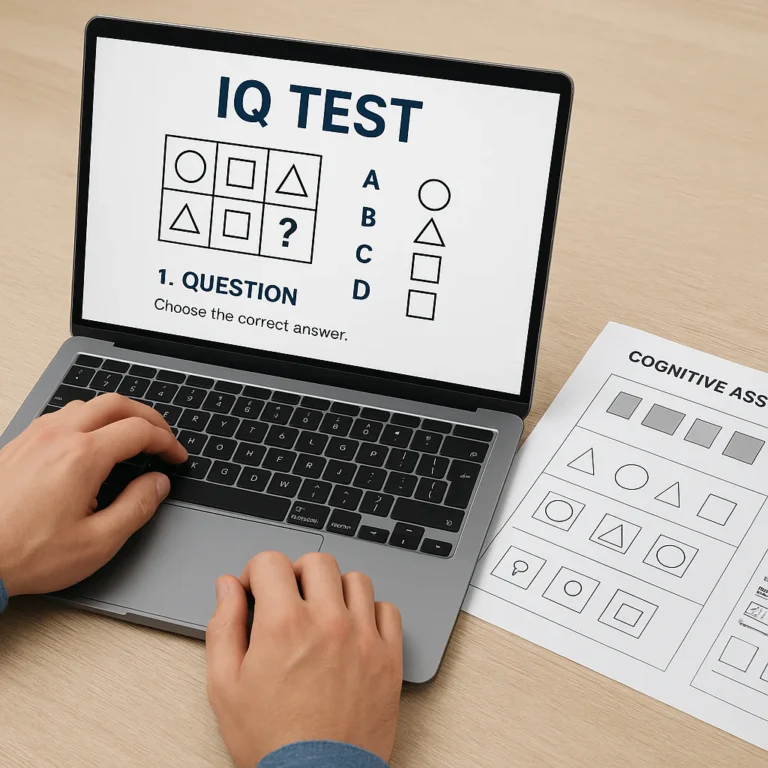
Here are 7 new search terms related to “Which IQ test is totally free?”—but a free online quiz is not automatically a scientifically validated IQ assessment. For a no-cost starting point, try reputable puzzle and practice resources such as Mensa’s sample questions, and check each site’s terms before you begin.
We’ve seen curious test-takers finish a quick quiz, get a surprising score, and wonder whether it sums up their intelligence. It doesn’t: an online result reflects performance on that particular set of questions, while a professional assessment uses standardized procedures and qualified interpretation.
The seven searches below cover what people really want to know: instant results, no registration, tests for adults or children, hidden fees, Mensa-style practice, and scientific validity. We’ll also separate IQ tests from brain games—because a relaxing word puzzle can be great fun without being an intelligence assessment.
Key Takeaways
- “Free” can mean different things: Check whether the questions, results, and report are all free, and whether registration is required.
- Online IQ scores are usually informal: Don’t use a casual quiz for clinical, school, or other high-stakes decisions.
- Choose based on your goal: Mensa sample questions are for practice; online quizzes can offer a casual challenge; professional assessments are formal evaluation.
- Compare tests cautiously: Different formats, scoring methods, and conditions mean their scores may not be directly comparable.
- Games are not IQ tests: Word puzzles and study apps can support practice or entertainment, but they don’t establish a standardized IQ score.
Table of Contents
- ⚡️ Quick Tips and Facts
- 🧠 What Does “Totally Free IQ Test” Actually Mean?
- Free IQ test vs. clinically administered IQ assessment
- Are free online IQ scores accurate?
- 📜 A Brief History of IQ Testing and Online Quizzes
- 🔎 Seven Search Terms Related to “Which IQ Test Is Totally Free?”
- 🧩 Seven Free IQ Tests and Practice Options to Consider
- 1. OpenPsychometrics Full Scale IQ Test
- 2. Mensa IQ Challenge
- 3. 123test Culture Fair Intelligence Test
- 4. Free-IQTest.net
- 5. IQTest.com
- 6. Arealme IQ Test
- 7. Brain Metrix IQ Test
- 📊 How These Free IQ Tests Compare
- Test length, question types, and score details
- Which tests are best for practice, curiosity, or learning?
- ✅ How to Choose a Free IQ Test You Can Trust
- 📝 How to Take an Online IQ Test for the Fairest Result
- 📈 Understanding IQ Scores, Percentiles, and Norms
- ⚠️ Common Free IQ Test Scams and Hidden Costs
- 🔐 Privacy, Data Collection, and Account Requirements
- ♿ Accessibility and Language Considerations
- 👧 Free IQ Tests for Children and Teens
- 🧑 ⚕️ When to Seek a Professional IQ Assessment
- 💡 What to Do After Taking a Free IQ Test
- 🎯 IQ Testing Myths and Misconceptions
- 🏁 Conclusion
- 🔗 Recommended Links
- ❓ FAQ
- Which IQ test is totally free?
- Can a free online IQ test give a real IQ score?
- Are free IQ tests accurate enough for Mensa admission?
- Do free IQ tests require payment to see results?
- How long does a free IQ test take?
- Can I retake an online IQ test?
- What is the most reliable way to measure IQ?
- 📚 Reference Links
⚡️ Quick Tips and Facts
Looking for which IQ test is totally free? The short version: some online tests let you answer questions and see results without paying, but that does not automatically make the score a professionally valid IQ measurement. For a broader selection, browse our free IQ tests and keep the distinction between a brain teaser and a standardized assessment firmly in view.
| Quick question | Helpful answer |
|---|---|
| Can you take an IQ test online for free? | ✅ Yes. Several sites offer free quizzes or sample questions. Check whether results are free too. |
| Does “free” mean scientifically validated? | ❌ No. A no-cost test may be entertaining or useful for practice without being normed or clinically validated. |
| What does an IQ score usually compare? | A person’s performance with a norm group, using a defined scoring system. Many standardized IQ scales use a mean of 100 and a standard deviation of 15. |
| Is one score a complete picture of intelligence? | ❌ No. Cognitive tests sample particular abilities under particular conditions; they do not measure every strength, skill, or life outcome. |
| How should you use an online result? | Treat it as a rough, informal snapshot, not a diagnosis, school placement decision, or prediction of your future. |
Our quick recommendation: Choose a test that clearly explains its format, scoring, time limit, and any payment or registration requirements. If the site promises a precise clinical score but says little about how it was developed, be skeptical. The American Psychological Association explains that psychological tests need evidence supporting their intended use and interpretation (APA testing standards overview).
There’s one more wrinkle: a popular “brain-training” game can be genuinely fun and still have nothing to do with measuring IQ. We’ll sort out that difference below.
🧠 What Does “Totally Free IQ Test” Actually Mean?
“Free IQ test” is a search phrase, not a guarantee. One website may let you answer every question but charge to reveal a detailed report. Another may show a score instantly yet provide no evidence that its test was standardized. A third may offer free sample questions but not a full assessment.
The research literature defines intelligence broadly as the ability to learn, reason, and solve problems, while emphasizing that IQ is inferred from performance on selected cognitive tests—not directly observed like height on a ruler (review of intelligence research). That distinction matters. An online quiz can measure how you performed on that quiz; whether the result supports a meaningful IQ interpretation depends on how the test was designed and normed.
Free IQ test vs. clinically administered IQ assessment
| Feature | Free online quiz or practice test | Professional IQ assessment |
|---|---|---|
| Typical purpose | Curiosity, puzzles, practice, or informal self-reflection | Answering a specific educational, clinical, or psychological question |
| Administration | Usually self-directed on a phone or computer | Given and interpreted by a qualified professional, often under standardized conditions |
| Score meaning | Varies widely; some sites do not explain norms | Based on a named instrument, standardized procedures, and formal interpretation |
| Feedback | Often an instant score or brief result | May include strengths, areas of difficulty, context, and recommendations |
| Best use | Fun challenge or low-stakes practice | Decisions that require dependable, individualized assessment |
A professional assessment is not simply an online quiz with a fancier report. The person administering it considers testing conditions, age, language, developmental history, and the reason for testing. The National Association of School Psychologists and the American Psychological Association offer guidance about psychological assessment and responsible test use.
Are free online IQ scores accurate?
They can be consistent with your performance on that particular test without being accurate measures of your overall IQ. Accuracy depends on questions such as:
- Was the test standardized on an appropriate, sufficiently large sample?
- Does it report reliability and validity evidence?
- Are the instructions, time limits, and scoring rules clear?
- Does it distinguish among verbal, visual, numerical, or other reasoning skills?
- Is the score being compared with a relevant norm group?
The research review cited above does not evaluate the free websites discussed in this article. So we can’t fairly use it as proof that any particular online test is accurate. What it does support is the more careful point: different tests measure different aspects of cognition, and scores depend on the assessment and conditions used (intelligence research review).
Our educators’ rule of thumb: An online score is a conversation starter, not a verdict. If you need a result for a clinical, educational, or formal eligibility decision, ask a qualified professional about an appropriate assessment.
📜 A Brief History of IQ Testing and Online Quizzes

IQ testing began as a way to assess cognitive skills using structured tasks. Over time, formal tests developed norm groups, standardized instructions, and scoring procedures. Today, online quizzes borrow familiar puzzle formats—number sequences, analogies, matrix patterns, and logic problems—but they do not all inherit the scientific groundwork of professional assessments.
The term “intelligence quotient” is historically familiar, but modern IQ scores are generally understood through standardized scales rather than as a literal ratio of mental age to chronological age. Many commonly used scales set the average score at 100, with a standard deviation of 15, though the exact test and interpretation matter (review of intelligence research).
Online testing has made puzzle-based challenges easy to access. It has also made it easy to confuse three different things:
- A standardized IQ assessment, built and evaluated for a defined purpose.
- An informal IQ-style quiz, which may be entertaining but have limited or undisclosed validation.
- A brain game, which exercises or tests a narrow skill but does not produce a valid IQ score.
That third category is where a calm word puzzle might sneak into search results looking like an intelligence test. We’ll give its proper label shortly.
🔎 Seven Search Terms Related to “Which IQ Test Is Totally Free?”
These related searches capture what people often want to know beyond simply finding a quiz. They’re useful starting points, but search wording alone does not establish that a test is reliable.
| Related search term | What the searcher probably wants to know |
|---|---|
| Free IQ test online with instant results | Can I finish and see a result without paying? |
| Accurate free IQ test with no registration | Can I avoid creating an account, and is the score credible? |
| Best free IQ test for adults | Which sites are easy to use and offer adult-oriented questions? |
| Free IQ test for kids | Is there an age-appropriate test, and should an adult be involved? |
| Online IQ test with no hidden fees | Will the site reveal its results and conditions before I start? |
| Free Mensa IQ test practice questions | Can I try reasoning puzzles similar in style to admission-test questions? |
| Are online IQ tests scientifically valid? | What evidence supports the test’s score and intended use? |
Notice how the searches mix access, cost, age suitability, and scientific validity. Those are different questions. A test can be free but not well validated; a sample can be from a respected organization but not a full assessment. For more answers about score interpretation and test types, visit our IQ Test FAQ.
🧩 Seven Free IQ Tests and Practice Options to Consider
The options below are online tests or practice resources, not endorsements of clinical accuracy. Features and site policies can change, so check the test page before you begin. We’ve focused on what each option appears useful for and where you should keep your expectations modest.
1. OpenPsychometrics Full Scale IQ Test
OpenPsychometrics offers a range of online psychological tests, including an IQ-style assessment. It’s a useful place to look if you want a more thoughtfully presented online quiz and an opportunity to explore cognitive-test formats.
What it may suit:
- Adults who enjoy structured reasoning questions.
- People interested in an informal estimate rather than an official report.
- Curious test-takers who want to inspect how a site presents its methods.
Keep in mind: An online result is not interchangeable with a professionally administered assessment. Look for the test’s explanation of scoring, comparison groups, and limitations before treating its number as meaningful.
2. Mensa IQ Challenge
Mensa International provides puzzle-style sample questions and practice activities. These can be a good way to experience reasoning challenges associated with high-IQ testing—but sample questions are not the same as an official admission test.
Best for: Trying pattern-recognition and logic puzzles in a Mensa-related context.
Not for: Claiming Mensa membership or treating a handful of practice questions as a verified IQ score. For official membership requirements and testing information, use Mensa’s own membership and testing pages.
3. 123test Culture Fair Intelligence Test
123test offers online IQ-style tests, including culture-fair reasoning formats. Visual pattern tasks can reduce reliance on language, but “culture fair” does not mean culture-proof or bias-free. Test performance can still be influenced by familiarity, education, visual conventions, and test-taking conditions.
Best for: A casual, nonverbal reasoning challenge and practice with abstract patterns.
Check before starting: Whether the particular version provides a free result, what additional report options are offered, and how the score is described. The site’s own description is the best place to verify current features.
4. Free-IQTest.net
Free-IQTest.net offers a quick online IQ-style quiz. It may appeal if you want a straightforward challenge without the feel of a long formal assessment.
Best for: Casual puzzle-solving and a quick, low-stakes result.
Limitations to consider: A short quiz is a narrow sample of performance. Before relying on its score, check whether the site explains its norms, reliability, and test-development process. “Instant” is convenient; it isn’t the same thing as “independently validated.”
5. IQTest.com
IQTest.com is another familiar name in online IQ-test searches. Before answering, inspect the result page and terms carefully so you know what information is free, whether an account is required, and whether any optional paid report is being offered.
Best for: People who want to compare question styles and experience a timed online assessment.
A sensible caution: Don’t assume a professionally designed-looking interface proves professional standardization. The test’s methodology and score interpretation matter more than the website’s visual polish.
6. Arealme IQ Test
Arealme presents an accessible, puzzle-oriented online IQ quiz. Its quick format may be entertaining, but treat the resulting score as informal unless the site provides strong evidence supporting a standardized interpretation.
Best for: A recreational challenge and comparing how you approach different reasoning questions.
Avoid: Taking several online quizzes in a row and averaging the numbers. Different tests use different questions, time limits, scoring methods, and norms, so that arithmetic would produce a very scientific-looking answer to a not-very-scientific question.
7. Brain Metrix IQ Test
Brain Metrix offers an online IQ-style quiz alongside other brain and cognitive activities. It can be a quick way to try a set of reasoning questions, especially if you’re treating the result as entertainment.
Best for: A casual quiz and a chance to practice puzzle-solving.
Limitations: Look for clear information about how scores are calculated and what population they are compared with. Without transparent evidence, the score should not be used for school, work, or clinical decisions.
What about Psych Tests, Brain Metrics, and IQExam.net?
A video summary also mentions Psych Tests, Brain Metrics, and IQExam.net as free testing or brain-fitness options. Those descriptions can help identify search leads, but claims such as “accurate scoring” or “valuable insights” should be verified on each provider’s current website. A confident adjective isn’t a validation study.
For another perspective, see the featured video, which presents free tests as convenient ways to challenge reasoning and practice. That’s a fair description of many online quizzes. The key qualification is that challenge and practice do not, by themselves, establish a valid IQ score.
📊 How These Free IQ Tests Compare
The best choice depends on what you want: a quick puzzle, a practice experience, or a result you can responsibly interpret. Here’s a practical comparison, with a crucial caveat: online services can update their tests, features, and access rules, so verify details on the official site.
| Option | What it’s generally useful for | Main caution | Free-result expectations |
|---|---|---|---|
| OpenPsychometrics | Exploring structured online testing | Informal result; check its methodology | Verify the current test page |
| Mensa sample questions | Trying Mensa-style reasoning puzzles | Samples are not official admission results | Practice content is available through Mensa |
| 123test | Visual and culture-fair-style reasoning practice | “Culture fair” is not a guarantee of bias-free measurement | Check the selected test’s result terms |
| Free-IQTest.net | A quick online quiz | Short tests provide a limited sample | Confirm result and report details |
| IQTest.com | Timed quiz experience | Check what is free and how scores are framed | Inspect the site before starting |
| Arealme | Casual puzzle challenge | Online score may not be standardized | Verify current result page |
| Brain Metrix | Informal IQ-style questions | Look for transparent norms and validation | Check the test itself |
Test length, question types, and score details
Online tests commonly include one or more of these question types:
- Pattern matrices: Pick the missing image or complete a visual sequence.
- Number sequences: Identify a numerical rule.
- Analogies: Find a relationship between words or concepts.
- Spatial reasoning: Mentally rotate or compare shapes.
- Verbal reasoning: Interpret relationships, vocabulary, or statements.
- Logic problems: Draw conclusions from given conditions.
These formats assess different skills. A test dominated by visual patterns may tell you little about verbal reasoning; a vocabulary-heavy quiz may be unfair to someone taking it in a second language. The research literature likewise notes that tests differ in content and may be timed or untimed (intelligence review).
Which tests are best for practice, curiosity, or learning?
| Your goal | Better starting point | Why |
|---|---|---|
| Try a few reasoning puzzles | Mensa sample questions | Useful practice without pretending to be a full assessment |
| Get a quick informal quiz result | Free-IQTest.net or Brain Metrix | Simple formats can be fun, but interpret scores cautiously |
| Explore a broader online test | OpenPsychometrics or 123test | Gives you more exposure to different question styles |
| Make an educational or clinical decision | A qualified psychologist or relevant professional | Formal decisions need appropriate tools and interpretation |
| Build a daily brain-game habit | A word or puzzle game | Can provide recreation and practice, but does not measure IQ |
Our educators have seen the same pattern many times: someone takes a short quiz late at night, gets a surprising number, and wonders whether it explains everything. It doesn’t. A score is one piece of information produced by one test in one moment.
✅ How to Choose a Free IQ Test You Can Trust
No free online test should earn your trust merely by using words like “official,” “scientific,” or “accurate.” Look for evidence, not sparkle.
A step-by-step checklist
-
Define your goal.
Are you looking for entertainment, practice, or information for a real-world decision? For a formal decision, start with a qualified professional rather than a free quiz. -
Check whether the result is actually free.
Look for a clear explanation of whether you’ll get a score without paying, registering, or submitting personal information. -
Read the test description.
Does it explain the skills measured, time limit, scoring, and intended age group? -
Look for norming and validation information.
A meaningful score depends on evidence about how the test performs and whom it was tested on. The APA’s testing standards resources explain why test quality and interpretation matter. -
Review the privacy policy.
Find out what personal data is collected and whether you can take the test without an account. -
Take it under sensible conditions.
Use a quiet setting, read instructions carefully, and avoid interruptions. Don’t take it while exhausted and then treat the score as a revelation. -
Interpret the result modestly.
Compare your performance with the test’s stated limitations, not with a dramatic label or a number from a different website.
✅ Good signs: Clear scoring explanations, transparent limitations, a stated purpose, and no pressure to buy a “secret” result.
❌ Warning signs: Guaranteed genius claims, hidden result fees, unexplained precision, urgency tactics, and no information about how scores are calculated.
📝 How to Take an Online IQ Test for the Fairest Result
Even a well-designed test can produce a less useful result if the conditions are chaotic. These steps won’t turn a casual quiz into a clinical assessment, but they can help you get a fairer read on your performance.
- Choose a quiet place. Put away notifications and let other people know you need a few uninterrupted minutes.
- Use a reliable device and connection. A frozen page during a timed test is a poor measure of reasoning.
- Check the rules first. Find out whether you can skip questions, return to earlier items, use scratch paper, or pause.
- Read each instruction carefully. Some mistakes come from rushing past the task directions, not from difficulty with the question.
- Work at a steady pace. If the test is timed, avoid spending all your time wrestling one stubborn puzzle.
- Don’t search for answers. If you’re using the quiz to learn about your own problem-solving, outside help makes the result less informative.
- Record context. Note the time of day, sleep, language, and any interruptions if you plan to compare results later.
- Avoid overinterpreting one attempt. A second score may change because you’ve seen similar items, learned the format, or had a better day.
A note from our educators: Practice can improve familiarity with a test format. That does not prove an underlying IQ has changed by the same amount. The test may be measuring your growing comfort with its particular puzzles.
📈 Understanding IQ Scores, Percentiles, and Norms
An IQ score is usually interpreted against a reference group. On many familiar standardized scales, 100 is the mean and 15 points is one standard deviation. That convention helps describe relative performance on the specific test; it does not make every website’s “IQ” score comparable.
| Term | Plain-language meaning |
|---|---|
| Mean | The average score in the test’s reference group |
| Standard deviation | A statistical description of how spread out scores are |
| Percentile | The proportion of the comparison group scoring at or below a given point |
| Norm group | The people whose results were used to interpret scores |
| Reliability | How consistently a test measures under appropriate conditions |
| Validity | Evidence that supports the intended interpretation and use of scores |
A percentile is not a percentage of questions answered correctly. If a result says “75th percentile,” it generally means the score is at or above the scores of about 75% of the relevant norm group—not that you got 75% of questions right.
The intelligence research review stresses that intelligence is inferred from test performance and that tests vary in their content and conditions. That’s why comparing a score from one informal website with a score from another can be like comparing race times recorded on two different courses using two different stopwatches.
Why scores can differ
- You may be rested for one test and tired for another.
- Questions may lean more heavily on verbal, numerical, or visual skills.
- Time limits may differ.
- The tests may use different scoring rules or comparison groups.
- Familiarity with similar puzzles can improve performance on a retake.
A score can provide useful context when interpreted appropriately. It cannot tell you everything about creativity, persistence, practical judgment, emotional skills, or how you’ll perform in a particular job. For more context on how IQ relates to public figures and common claims, see Famous IQ Scores.
⚠️ Common Free IQ Test Scams and Hidden Costs
A legitimate free quiz can have optional paid features. The problem is when the site makes the free part unclear or uses pressure to make you pay for a result you thought you were already getting.
Watch for:
- The results paywall: You complete a long quiz, then discover that the score or report costs extra.
- The “99% accurate” claim: A precise-sounding promise with no supporting methodology.
- The countdown trap: A timer or limited-time offer designed to rush a payment decision.
- The vague subscription: Terms that do not clearly explain recurring billing or cancellation.
- The personal-data grab: Requests for unnecessary identifying details before showing basic results.
- The fake authority badge: “Certified” or “official” language without a named test publisher or credentialed administrator.
Before you start, check whether the results are free, whether registration is required, and whether optional products or subscriptions are clearly labeled. If payment is required for a report, compare the offer with what the provider actually explains about test development. A polished certificate is not evidence of a standardized assessment.
🔐 Privacy, Data Collection, and Account Requirements
IQ-test answers and results can feel personal, even when you take a casual quiz. Before sharing your name, email, age, or other data, look for a privacy policy that explains what the site collects, how long it keeps the data, and whether it shares information with third parties.
A few practical habits help:
- Prefer a test that doesn’t require unnecessary identifying details.
- Use a unique password if you create an account.
- Don’t submit sensitive medical or educational information to an unfamiliar quiz site.
- Review whether you can delete your account or test history.
- Be cautious about sites that ask for social-media access or contact lists.
Online assessments may also collect technical data, such as device or usage information. The U.S. Federal Trade Commission offers general guidance on protecting personal information online through its consumer privacy resources.
♿ Accessibility and Language Considerations
A test is only useful if you can access and understand it. Before starting, consider:
- Language: Vocabulary-heavy tests may disadvantage people who are less fluent in the test language.
- Vision: Small images, low contrast, or time pressure can make visual puzzles harder to use.
- Motor access: Drag-and-drop tasks may be difficult with some assistive devices.
- Reading demands: Long instructions can affect performance independently of reasoning.
- Device size: A compact phone screen can make matrix puzzles uncomfortable or harder to compare.
- Neurodiversity and accommodations: Many informal online tests do not offer a way to adjust testing conditions.
If you need accommodations or a score for a formal purpose, ask a qualified professional about accessible assessment options. A result from an inaccessible quiz should not be used to draw broad conclusions about your abilities.
👧 Free IQ Tests for Children and Teens
Children’s cognitive abilities and test interpretation depend on age and development. An adult-oriented online quiz may use vocabulary, assumptions, timing, or visual conventions that aren’t appropriate for a child.
For parents and caregivers:
- Don’t use a casual online score to label a child as “gifted,” “behind,” or “not capable.”
- If you have concerns about learning, development, or school support, speak with the child’s teacher, pediatrician, or school psychologist.
- Use age-appropriate puzzles as play and practice, not as diagnosis.
- Consider how sleep, stress, language, attention, and accessibility may affect performance.
- Avoid making a child retake tests to chase a higher number; that can turn curiosity into pressure.
The National Association for Gifted Children provides resources for families and educators. For formal concerns, a school psychologist or licensed psychologist can help identify the right assessment and explain what the results do—and do not—mean.
🧑 ⚕️ When to Seek a Professional IQ Assessment
Consider a professionally administered assessment when the result could influence an important decision, such as:
- Educational planning or learning-support decisions.
- Evaluation of cognitive strengths or difficulties.
- Clinical assessment recommended by a qualified healthcare provider.
- A formal program organization’s documented testing requirement.
- Understanding a complex learning or developmental profile.
Ask the professional:
- What question will the assessment answer?
- Which test or tests are appropriate, and why?
- What qualifications does the examiner have?
- How will language, disability, health, or testing conditions be considered?
- What will the report include, and who can access it?
A professional assessment also has limits. It is a structured view of selected abilities, not a complete map of a person’s potential. The research review puts the broader principle neatly: “an individual is always more than the sum of their genes or their IQ scores” (intelligence research review).
💡 What to Do After Taking a Free IQ Test
Got a score? Before declaring yourself a hidden genius—or blaming your browser—try this:
- Read the site’s explanation. Check what the score represents and whether the test explains its limitations.
- Separate performance from identity. You answered a particular set of questions under particular conditions. That is not your entire intelligence.
- Look at patterns, not just totals. Did you find visual puzzles easier than verbal ones? That may be interesting, but an informal quiz cannot establish a formal profile.
- Use missed questions as practice. Work through the reasoning, then try similar puzzles later.
- Don’t compare unrelated scores. Different online tests may not use compatible scales.
- Seek a professional if the stakes are high. Don’t use an online quiz as a substitute for a proper evaluation.
If your goal is improving how you think and learn, focus on practical habits: read widely, learn new skills, practice reasoning puzzles, sleep adequately, and get help for persistent learning difficulties. These are sensible ways to support everyday cognitive performance, though they do not guarantee a lasting increase in IQ. Explore our IQ and Career Development resources for the broader connection between skills, learning, and work.
🎯 IQ Testing Myths and Misconceptions
“If the website calls it an IQ test, the score must be real.”
❌ A label is not evidence. Look for information about standardization, reliability, validity, and intended use.
“A free test can’t be useful.”
✅ It can be useful for practice, entertainment, and curiosity. It simply shouldn’t be treated as a clinical or educational assessment without adequate evidence.
“A higher retake proves my IQ increased.”
❌ You may have learned the question style, remembered items, or taken the second test in better conditions. Practice effects and test familiarity can change performance.
“Culture-fair means culturally neutral.”
❌ Visual or nonverbal tasks may reduce some language demands, but they cannot guarantee that every person has the same background or familiarity.
“IQ predicts exactly what someone will achieve.”
❌ Test scores can relate to some educational and occupational outcomes, but they don’t determine a person’s future. The research review emphasizes the probabilistic nature of individual predictions (intelligence research review).
“Brain-training games are IQ tests.”
❌ A game can challenge memory, spelling, vocabulary, or pattern recognition without measuring IQ. That brings us to the game that search results sometimes put in the wrong mental drawer.
🧩 Is Zen Word® an IQ Test?
No. Zen Word® – Relax Puzzle Game is a word puzzle game by OAKEVER GAMES PTE. LTD., not an IQ assessment. Its App Store listing describes connecting letters to find hidden words, with levels averaging about 20 words, a relaxed pace, and nature-themed backgrounds. It does not claim to provide an IQ score or to be a scientifically validated intelligence test.
That distinction does not make Zen Word less enjoyable. It simply gives it the right job title.
| Feature | What it offers | What it does not establish |
|---|---|---|
| Word puzzles | Letter and vocabulary challenges | A standardized IQ score |
| Relaxed play | No countdown pressure described in the listing | Clinical assessment or diagnosis |
| Brain-game appeal | A recreational way to practice word finding | Proof that gameplay raises IQ |
| Free download | The listing describes the app as free with in-app purchases | A fully free experience with no optional purchases |
The listing includes user feedback in both directions. One reviewer praises the calming music, challenging levels, hints, side games, and updates, saying, “I ABSOLUTELY love this game!” Another describes frustration with banners, event interruptions, ads, and Expert mode restrictions. The developer response says ad-removal generally covers interruptive gameplay ads while some optional or feature-related ads may remain, and invites users to report issues through Settings > Help Center (App Store listing). These are individual experiences, not a representative survey, so we should treat them as useful examples rather than universal verdicts.
The app listing also discloses in-app purchases and a subscription option. The listed Word Club subscription renews automatically unless canceled at least 24 hours before renewal; the listing says users manage subscriptions through their store account settings. Check the current listing and terms for the latest details before subscribing.
So what should you choose? Pick a free IQ-style test if you want reasoning questions and an informal result. Pick Zen Word if you want a word-finding game. If you want to strengthen vocabulary or spelling habits, a word game may be a pleasant practice tool—but it does not certify your IQ.
🧠 Brain Games, Practice, and IQ: What’s the Difference?
Brain games can provide enjoyable practice in a particular activity. An IQ test has a different purpose: it aims to measure selected cognitive skills through a defined assessment and scoring process. Even when they share puzzle formats, their goals are not interchangeable.
| Activity | Example | What it may help you do | What it does not prove |
|---|---|---|---|
| IQ-style online quiz | Pattern matrix quiz | Try reasoning items and get informal feedback | Your professionally measured IQ |
| Word puzzle game | Zen Word | Practice word finding and vocabulary in a game format | A standardized intelligence score |
| Study tool | Flashcards or a quiz made from notes | Review learned information | General cognitive ability |
| Professional assessment | Standardized psychologist-administered test | Address a formal evaluation question | Every aspect of a person’s potential |
The QR Reader for iPhone App Store listing illustrates another useful distinction. It describes scanning features for documents and study materials, including tools that can turn scanned content into quizzes or flashcards. Those are learning and study aids, not IQ tests. The app is listed as free with in-app purchases, so “free to download” should not be confused with “every feature is free.”
Curiosity resolved: a soothing word game, a QR-based flashcard tool, and an IQ-style quiz can all be free to start, but none becomes a valid IQ assessment just because it contains puzzles. Use each tool for what it actually does—and you’ll be much less likely to end up with a score, a subscription, and a mystery you never meant to solve.