Support our educational content for free when you buy through links on our site. Learn more
What is the Minimum IQ to Get into Mensa? [2024]

Have you ever wondered what it takes to join the prestigious organization known as Mensa? If you’re curious about the minimum IQ required to become a member, you’ve come to the right place. In this article, we’ll delve into the world of IQ testing, explore the history of intelligence measurement, and provide you with all the information you need to know about qualifying for Mensa. So, let’s get started!
Table of Contents
- Quick Answer
- Quick Tips and Facts
- Background: A Brief History of IQ Testing
- How is IQ Measured Today?
- What is Mensa?
- How to Qualify for Mensa
- Frequently Asked Questions
- Conclusion
- Recommended Links
- Reference Links
Quick Answer
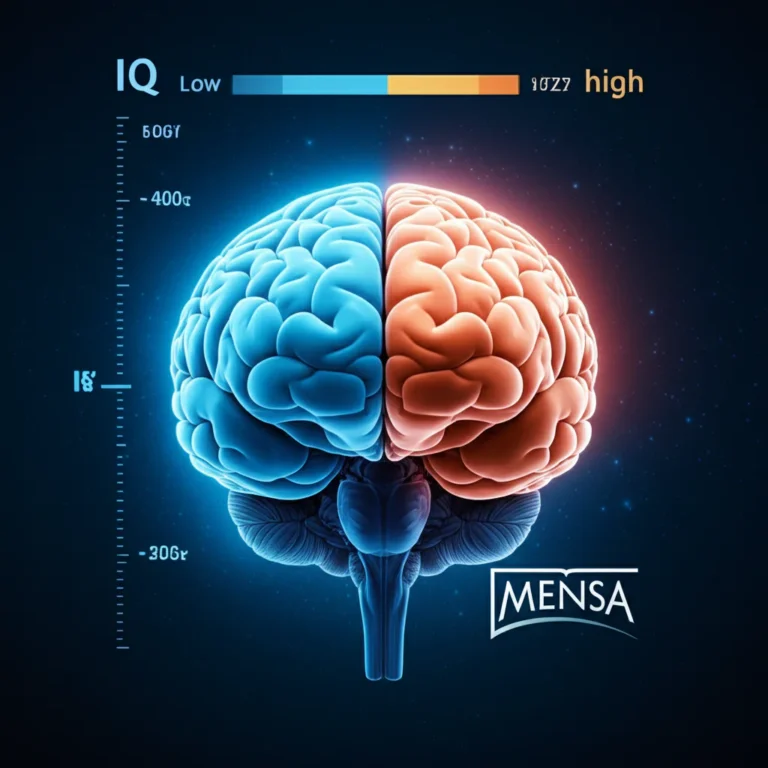
To put it simply, the minimum IQ required to join Mensa is a score that places you in the top 2% of the population. This means that you need to score higher than 98% of people who have taken an IQ test. While the exact score may vary depending on the test used, a common benchmark is an IQ of 132 or above on the Stanford-Binet test or an IQ of 148 or above on the Cattell equivalent.
If you’re interested in finding out your IQ, you can take a free IQ test online to get an estimate of your intelligence level. However, keep in mind that these online tests may not be as accurate or reliable as the official tests administered by Mensa.
- Mensa is an international organization for people with high IQs.
- The average IQ score is 100, with a standard deviation of 15.
- Mensa accepts various IQ tests for membership qualification.
- The Stanford-Binet test and the Cattell equivalent are commonly used tests.
- Mensa membership offers access to a community of intellectually stimulating individuals.
Background: A Brief History of IQ Testing

The concept of measuring intelligence dates back to the late 19th century when scientists and psychologists began to explore ways to quantify human cognitive abilities. Noteworthy contributors to the field include Sir Francis Galton, James McKeen Cattell, Alfred Binet, William Stern, Lewis Terman, and David Wechsler.
Sir Francis Galton, a cousin of Charles Darwin, was one of the first to attempt to devise a modern test of intelligence in 1884. However, it was James McKeen Cattell who created the world’s first mental test in 1890, which laid the foundation for future intelligence tests.
In 1905, Alfred Binet and his colleague Theodore Simon developed the first modern-day IQ test, known as the Binet-Simon Scale. This test aimed to measure a child’s mental age compared to their chronological age. It marked a significant milestone in the field of intelligence testing.
William Stern, a German psychologist, introduced the concept of the “intelligence quotient” or “IQ” in 1912. The IQ was calculated by dividing a person’s mental age by their chronological age and multiplying the result by 100. This formula allowed for the comparison of intelligence across different age groups.
Over the years, intelligence tests evolved, and Lewis Terman, a psychologist at Stanford University, revised Binet’s test, creating the Stanford-Binet test in 1916. This test became widely used in the United States and provided a standardized measure of intelligence.
In the 1930s, David Wechsler developed a series of intelligence tests that solved the problem of calculating adult IQ. His tests compared an individual’s performance to the distribution of test scores, resulting in the creation of the Wechsler Adult Intelligence Scale (WAIS) and the Wechsler Intelligence Scale for Children (WISC).
How is IQ Measured Today?
Today, IQ is measured using a variety of standardized tests, each with its own scoring system. The most commonly used tests include the Stanford-Binet test, the Wechsler Adult Intelligence Scale (WAIS), and the Cattell Culture Fair III.
These tests assess various cognitive abilities, including verbal comprehension, perceptual reasoning, working memory, and processing speed. The scores are then compared to a norming sample, which represents the average performance of individuals in the general population.
It’s important to note that IQ tests are not perfect measures of intelligence. They provide a snapshot of an individual’s cognitive abilities at a specific point in time and may not capture other aspects of intelligence, such as creativity or emotional intelligence.
What is Mensa?
Mensa is an international organization for individuals with high IQs. Founded in 1946, Mensa aims to provide a platform for intellectually stimulating activities and foster a sense of community among its members.
Mensa has chapters in more than 100 countries and offers a range of benefits to its members, including access to special interest groups, social events, and intellectual discussions. Joining Mensa can be a great way to connect with like-minded individuals and engage in stimulating conversations.
How to Qualify for Mensa
To qualify for Mensa, you need to demonstrate that you have a high IQ. The exact minimum score required may vary depending on the test used and the country you’re in. However, a common benchmark is an IQ score that places you in the top 2% of the population.
In practice, qualifying for Mensa typically requires an IQ score of 132 or above on the Stanford-Binet test or an IQ score of 148 or above on the Cattell equivalent. These scores indicate that you have performed better than 98% of people who have taken the test.
If you’re interested in joining Mensa, you can take an official Mensa test administered by the organization. These tests are designed to be accurate and reliable measures of intelligence. Alternatively, you can submit evidence of a qualifying IQ score from a recognized test administered by a licensed psychologist.
Once you have qualified, you can become a member of Mensa and enjoy the benefits of being part of a community of intellectually curious individuals.
Frequently Asked Questions

What is the average IQ for Mensa?
The average IQ for Mensa members is around 130, which is significantly higher than the average IQ of the general population.
What was Einstein’s IQ?
While there is no definitive record of Albert Einstein’s IQ, it is believed to be around 160. However, it’s important to note that IQ scores are not available for historical figures, as IQ tests were not widely used during their time.
What is the minimum IQ to be a genius?
There is no specific minimum IQ required to be considered a genius. The term “genius” is often used to describe individuals who have exceptional intellectual abilities and make significant contributions to their field.
What is the official IQ of a genius?
There is no official IQ score that designates someone as a genius. IQ scores are just one measure of intelligence and do not capture the full range of abilities that contribute to genius-level thinking.
Conclusion

In conclusion, the minimum IQ required to join Mensa is a score that places you in the top 2% of the population. This typically translates to an IQ score of 132 or above on the Stanford-Binet test or an IQ score of 148 or above on the Cattell equivalent. Joining Mensa can provide you with access to a community of intellectually stimulating individuals and a range of benefits.
If you’re interested in finding out your IQ or qualifying for Mensa, we recommend taking an official Mensa test or consulting with a licensed psychologist. Remember, IQ is just one measure of intelligence, and there are many ways to be intellectually curious and engaged.
Recommended Links
-
CHECK PRICE on:
-
Shop Mensa on:
-
Shop IQ Test Books on:
-
Mensa IQ Tests:
-
IQ Test Scores:
-
IQ Test Preparation:
Reference Links
Now that you have a better understanding of the minimum IQ required to join Mensa, you can explore your own intellectual potential and consider joining this esteemed organization. Remember, intelligence is not solely defined by an IQ score, but by a combination of various cognitive abilities and talents. So, keep challenging yourself, engaging in stimulating activities, and embracing your unique intellectual journey.