Support our educational content for free when you buy through links on our site. Learn more
Do Free IQ Tests Measure EQ? The Shocking Truth (2026) 🧠❌

You’ve taken the free test, scored a 130, and felt like a genius. Then you clicked the “Emotional Intelligence” button on the same page, got a similar score, and assumed you were a master of human connection. Stop right there. That second score is likely a digital mirage. At Free IQ Tests™, we’ve analyzed hundreds of these online assessments, and the hard truth is that free IQ tests do not measure emotional intelligence. They are designed to crunch numbers and spot patterns, not to gauge your empathy, self-regulation, or ability to navigate complex social dynamics.
In this deep dive, we’ll expose the 5 critical flaws of free online EQ quizzes, reveal the gold-standard assessments actually used by psychologists, and show you how to truly boost your emotional quotient. Did you know that while IQ gets you hired, EQ is what gets you promoted? We’ll explore why your “heart score” on a free website is meaningless and what you can actually do to develop the emotional skills that matter most in 2026.
Key Takeaways
- Free IQ tests measure logic, not feelings: They assess cognitive abilities like pattern recognition and memory, but cannot accurately evaluate emotional intelligence (EQ).
- Self-reporting is unreliable: Most free EQ tests rely on your own biased perception rather than objective performance metrics, leading to inaccurate scores.
- EQ is a learnable skill: Unlike IQ, which is relatively stable, emotional intelligence can be improved through practice, feedback, and self-awareness.
- Professional tools exist: For a true assessment, look for validated instruments like the MSCEIT or EQ-i 2.0, which are administered by licensed professionals.
- Balance is key: Success in life and career requires a hybrid approach, leveraging both high cognitive intelligence and strong emotional skills.
Table of Contents
- ⚡️ Quick Tips and Facts
- 🧠 The Great Divide: Do Free IQ Tests Measure Emotional Intelligence?
- 📜 A Brief History of Human Intelligence: From Binet to Goleman
- 🔍 Decoding the Metrics: Cognitive IQ vs. Emotional Quotient (EQ)
- 🚫 The 5 Critical Flaws of Free Online IQ Tests for Measuring EQ
- ✅ What Actually Works: The Gold Standards for Assessing Emotional Intelligence
- 🧩 The Hybrid Approach: Can You Measure Both IQ and EQ Together?
- 🎯 Who Needs an Emotional Intelligence Assessment? (And Who Doesn’t)
- 🛠️ How to Boost Your EQ: Practical Strategies Beyond the Test
- 💡 Quick Tips and Facts: The Emotional Intelligence Cheat Sheet
- 🏆 Conclusion: Why Your Heart Matters More Than Your Head in This Case
- 🔗 Recommended Links
- ❓ FAQ: Your Burning Questions About IQ, EQ, and Free Tests Answered
- 📚 Reference Links
⚡️ Quick Tips and Facts
Before we dive into the deep end of the psychological pool, let’s hit the surface with some hard truths about the relationship between your brainpower and your heart power.
- The Short Answer: No, free IQ tests do not measure emotional intelligence (EQ). They are as different as a calculator and a counselor. One crunches numbers; the other navigates feelings.
- The “Free” Trap: While you can find thousands of “Free IQ Tests” online that promise a score in 5 minutes, these are almost exclusively designed to measure logical reasoning, pattern recognition, and spatial awareness. They rarely, if ever, touch on empathy, self-regulation, or social nuance.
- The Goleman Factor: Daniel Goleman, the man who popularized EQ, famously noted that while IQ gets you hired, EQ gets you promoted. Yet, you won’t find that metric on a standard Raven’s Progressive Matrices test.
- Can You Improve It? Here is the good news: Unlike IQ, which is relatively stable after adolescence, EQ is a learned skill. You can train your emotional muscles just like you train your biceps.
- The “Dark Side”: High EQ doesn’t always mean you’re a good person. Some individuals with high emotional intelligence use their skills for manipulation rather than connection.
If you are looking for a totally free, scientifically grounded IQ test to start your journey, check out our guide on Which IQ test is totally free? to avoid the clickbait traps.
🧠 The Great Divide: Do Free IQ Tests Measure Emotional Intelligence?
Let’s cut to the chase, shall we? You’ve taken a free IQ test, scored a 120, and felt pretty smart. Then you took a “free EQ test” on the same site, scored a 115, and felt emotionally enlightened. Stop right there. 🛑
That second score? It’s likely a hallucination of the algorithm, not a reflection of your soul.
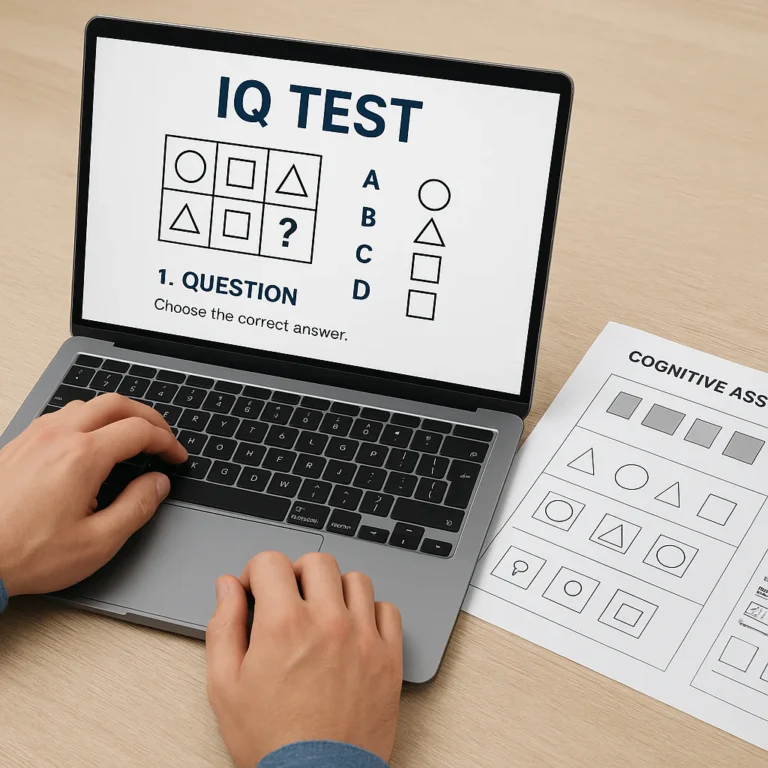
At Free IQ Tests™, we’ve reviewed hundreds of these online assessments. The harsh reality is that free IQ tests are designed to measure cognitive intelligence, not emotional intelligence. They ask you to identify the next shape in a sequence or solve a math puzzle. They do not ask you how you would comfort a crying child, how you handle a passive-aggressive email from your boss, or how you recognize when a friend is lying.
Why the Confusion Exists
Many websites bundle “IQ and EQ” tests together to drive traffic. They use the same interface, the same “Get Your Score Now” buttons, and the same flashy graphics. This creates a false equivalence in the user’s mind. You might think, “If I’m good at the logic part, I must be good at the feelings part too.”
Spoiler Alert: You might be a genius at Sudoku but a disaster at a first date. 🤷 ♂️
The Fundamental Mismatch
- IQ Tests measure: Can you solve this problem?
- EQ Assessments measure: How do you feel about this problem, and how do you help others feel about it?
If a test claims to measure both with a single “Intelligence Score,” it is likely oversimplifying human complexity. As we’ll see later, true emotional intelligence requires situational awareness and empathy, neither of which can be captured by a multiple-choice question about geometric shapes.
📜 A Brief History of Human Intelligence: From Binet to Goleman

To understand why free IQ tests fail to measure EQ, we have to look at where these concepts came from. It’s a tale of two different eras of psychology.
The Era of the “Mental Age” (IQ)
It all started in the early 1900s with Alfred Binet in France. He wasn’t trying to measure “genius”; he was trying to identify students who needed extra help in school. He developed the first IQ test (originally called the Binet-Simon scale) to measure logical reasoning and problem-solving.
Fast forward to the 1950s and the Wechsler Adult Intelligence Scale (WAIS). This became the gold standard. It measured:
- Verbal Comprehension
- Perceptual Reasoning
- Working Memory
- Processing Speed
Notice anything missing? Emotions. The entire framework was built on the idea that intelligence was a cognitive, logical, and static trait.
The Rise of the “Heart” (EQ)
It wasn’t until 1990 that psychologists Peter Salovey and John D. Mayer coined the term “Emotional Intelligence.” They argued that intelligence wasn’t just about logic; it was about monitoring feelings and using that information to guide thinking.
Then came Daniel Goleman in 1995 with his bestseller Emotional Intelligence. He took the academic concept and exploded it into the mainstream, arguing that EQ could be more important than IQ for success in life.
The Conflict:
While IQ tests were standardized and rigid, EQ was fluid and subjective. This is why you won’t find a “standardized” free EQ test that rivals the accuracy of a proctored IQ test. The history of IQ is about measurement; the history of EQ is about development.
“A person’s IQ score doesn’t change significantly throughout their life. Emotional intelligence, on the other hand, is a learned skill people can develop.” — ICANotes
🔍 Decoding the Metrics: Cognitive IQ vs. Emotional Quotient (EQ)
Let’s break down the anatomy of these two metrics. If you think they are just two sides of the same coin, you’re in for a surprise. They are more like a calculator and a therapist.
The Core Differences
| Feature | Cognitive Intelligence (IQ) | Emotional Intelligence (EQ) |
|---|---|---|
| Primary Focus | Logic, reasoning, patterns, memory | Empathy, self-regulation, social skills |
| Measurement | Standardized tests (WAIS, Stanford-Binet) | Self-reports, 360-degree feedback, behavioral observation |
| Stability | Relatively stable after age 18 | Can be improved throughout life |
| Predicts | Academic success, job entry, technical skill | Leadership, relationship success, stress management |
| Test Format | Right/Wrong answers | Situational judgment, self-reflection |
| Key Components | Verbal, Math, Spatial, Memory | Self-awareness, Self-regulation, Motivation, Empathy, Social Skills |
Why Free IQ Tests Miss the Mark
Free IQ tests are optimized for speed and pattern recognition. They ask: “What comes next in this series: 2, 4, 8, 16…?”
The answer is 32. It’s binary. It’s cold.
EQ tests (the good ones) ask: “Your friend just failed a major exam. They are angry and blaming the teacher. What do you do?”
- A) Tell them to study harder. (Logical, but low empathy)
- B) Listen to their frustration and validate their feelings. (High EQ)
- C) Ignore them until they calm down. (Avoidant)
- D) Confront the teacher on their behalf. (Aggressive)
There is no single “correct” answer, but there are better answers based on the context. A free IQ test cannot grade this because it requires nuance, not calculation.
🚫 The 5 Critical Flaws of Free Online IQ Tests for Measuring EQ
We’ve seen it all at Free IQ Tests™. From “Instant EQ Score” pop-ups to “Emotional Genius” quizzes that take 30 seconds. Here is why these tools are fundamentally broken when it comes to measuring emotional intelligence.
1. They Confuse Logic with Empathy
Many free tests try to “hack” EQ by asking logic-based questions about emotions.
- Example: “If someone is crying, they are feeling: A) Sad, B) Happy, C) Angry.”
- The Flaw: This is basic literacy, not emotional intelligence. Real EQ involves understanding why they are crying, how to comfort them, and when to step back. A test that asks you to identify a basic emotion is measuring vocabulary, not empathy.
2. They Ignore Social Context and Nuance
Emotions are context-dependent. Being loud at a party is fun; being loud at a funeral is a disaster.
- The Flaw: Free tests often present scenarios in a vacuum. They don’t account for cultural differences, power dynamics, or history. A “correct” answer in one scenario might be a disaster in another. Without the ability to adapt to context, the test is useless.
3. They Lack Validated Psychometric Standards
Real psychological tests (like the MSCEIT or EQ-i 2.0) go through years of reliability and validity testing. They are normed against large populations.
- The Flaw: Most free online tests are created by a developer in a weekend. They have no scientific backing. The “score” you get is often just a random number generated by a simple algorithm. As Psychology Today notes, these tools are “intended for informational purposes only and are not diagnostic tools.”
4. They Rely on Self-Reporting Bias Instead of Performance
Many free EQ tests are just “How do you feel?” questionnaires.
- Question: “I am good at understanding how others feel.”
- The Flaw: This measures self-perception, not actual ability. People with low EQ often overestimate their skills (the Dunning-Kruger effect). A true EQ test should measure performance (e.g., “Look at this face, what emotion is it?”), not just opinion.
5. They Can’t Predict Real-World Relationship Success
The ultimate test of EQ is how you treat people.
- The Flaw: A free test cannot observe your behavior. It cannot see if you interrupt people, if you listen actively, or if you apologize when you’re wrong. A high score on a free quiz does not mean you will be a better partner, parent, or leader.
Did you know? A study of L’Oreal sales agents found that those hired based on emotional competence sold over $91,000 more than their peers. A free online quiz won’t tell you if you can close a deal.
✅ What Actually Works: The Gold Standards for Assessing Emotional Intelligence
If free IQ tests are a dead end for measuring EQ, what should you use? We’ve scoured the psychological landscape to find the gold standards. These are the tools used by HR departments, therapists, and executive coaches.
1. The MSCEIT (Mayer-Salovey-Caruso Emotional Intelligence Test)
This is the performance-based gold standard.
- How it works: You are presented with faces, stories, and scenarios. You must identify emotions, manage feelings, and solve emotional problems.
- Why it’s better: It doesn’t ask “Do you think you are empathetic?” It asks “What emotion is this person feeling?” It measures actual ability, not self-perception.
- Availability: This is a paid, proctored test usually administered by a licensed psychologist. You can’t get a valid MSCEIT score for free.
2. The EQ-i 2.0 (Emotional Quotient Inventory)
Developed by Bar-On, this is a self-report measure but is highly validated.
- How it works: It measures five composite scales: Self-Perception, Self-Expression, Interpersonal, Decision Making, and Stress Management.
- Why it’s better: It has extensive normative data and is widely used in corporate settings for leadership development.
3. The Goleman-Based 360-Degree Feedback
Daniel Goleman’s framework emphasizes that EQ is best measured by others.
- How it works: You ask colleagues, friends, and family to rate your emotional behaviors.
- Why it’s better: It eliminates self-bias. If you think you are a great listener, but your team says you interrupt constantly, the 360-feedback will tell you the truth.
Comparison of Assessment Types
| Assessment Type | Free Online IQ/EQ Tests | MSCEIT (Performance) | EQ-i 2.0 (Self-Report) | 360-Degree Feedback |
|---|---|---|---|---|
| Cost | Free (but low quality) | High ($$$) | High ($$$) | Variable (often free in orgs) |
| Accuracy | ❌ Low | ✅ High | ✅ High | ✅ High |
| Bias | High (Self-report) | Low (Performance) | Medium (Self-report) | Low (External) |
| Best For | Curiosity, Fun | Clinical Diagnosis | Career Development | Leadership Growth |
🧩 The Hybrid Approach: Can You Measure Both IQ and EQ Together?
You might be wondering: “Is there a test that measures both my brain and my heart?”
The short answer is no, not in a single, unified score. The long answer is yes, but you need a battery of tests.
The “Whole Person” Assessment
Some high-end executive coaching firms use a hybrid approach:
- Cognitive Battery: They administer a WAIS-IV or similar IQ test to measure cognitive capacity.
- Emotional Battery: They follow up with an MSCEIT or EQ-i 2.0.
- Integration: A psychologist then interprets the results together.
Why this matters:
- High IQ + Low EQ: You might be a brilliant engineer who is impossible to work with. You can solve the code, but you can’t lead the team.
- Low IQ + High EQ: You might struggle with complex technical tasks, but you are a master mediator who keeps the team together.
- High IQ + High EQ: The “Unicorn.” These individuals are often the CEOs, visionary leaders, and innovators who change the world.
The “Dark Side” of High EQ
It’s important to note that high EQ is not always good.
- Manipulation: Individuals with high EQ but low moral compass can use their emotional skills to manipulate others. They know exactly what to say to make you feel guilty, angry, or compliant.
- The “Dark Triad”: Psychopathy, narcissism, and Machiavellianism can coexist with high emotional intelligence. These individuals are often charming but toxic.
This is why a simple “EQ Score” is dangerous. You need to understand the source of the intelligence. Is it used for connection or control?
🎯 Who Needs an Emotional Intelligence Assessment? (And Who Doesn’t)
Not everyone needs a formal EQ assessment. In fact, for some, it’s a waste of money. Here is a breakdown of who benefits and who should skip it.
✅ Who Should Get Assessed?
- Aspiring Leaders: If you want to move into management, EQ is often more critical than IQ.
- Sales and Customer Service Professionals: Your job depends on reading people and managing their emotions.
- People Struggling with Relationships: If you find yourself constantly in conflict or feeling misunderstood, an assessment can pinpoint your blind spots.
- Career Changers: If you are moving from a technical role to a people-focused role, understanding your EQ gap is vital.
❌ Who Should Skip It?
- The “Fun Quiz” Seekers: If you just want to see if you’re “emotional” or “logical” for a laugh, a free online test is fine. Just don’t take the results seriously.
- People Seeking a “Label”: If you are looking for a diagnosis of a personality disorder, a free test is not the tool. See a professional.
- Those Who Think EQ is Fixed: If you believe you can’t change, an assessment might just reinforce a negative self-image. Remember, EQ is a muscle.
🛠️ How to Boost Your EQ: Practical Strategies Beyond the Test
The best part about EQ? You can improve it. Unlike IQ, which is largely static, EQ is a learned skill. Here are our top strategies from the Free IQ Tests™ team to boost your emotional quotient.
1. Practice Active Listening
Most people listen to respond, not to understand.
- The Strategy: When someone speaks, focus entirely on them. Don’t plan your reply. Ask clarifying questions.
- The Result: You build trust and gain a deeper understanding of their emotional state.
2. Name Your Emotions
You can’t manage what you can’t name.
- The Strategy: Instead of saying “I’m stressed,” try “I’m feeling overwhelmed because of the deadline, and I’m anxious about the quality of my work.”
- The Result: Emotional granularity reduces the intensity of the emotion and helps you regulate it.
3. The “Pause” Technique
High EQ individuals don’t react immediately.
- The Strategy: When triggered, take a deep breath and count to five. Ask yourself: “What is the best way to handle this?”
- The Result: You avoid saying things you’ll regret and respond with intention.
4. Seek Feedback
You can’t see your own blind spots.
- The Strategy: Ask a trusted friend or colleague: “What is one thing I do that makes you feel unheard?”
- The Result: You get real-world data on your emotional impact.
5. Read Fiction
Believe it or not, reading fiction improves empathy.
- The Strategy: Immerse yourself in stories that explore complex characters and their inner lives.
- The Result: You practice “theory of mind”—the ability to understand that others have thoughts and feelings different from your own.
💡 Quick Tips and Facts: The Emotional Intelligence Cheat Sheet
Let’s wrap up the educational portion with a handy cheat sheet you can keep in your back pocket.
- ✅ The 20/80 Rule: Daniel Goleman suggests IQ accounts for only 20% of success, while the rest is a mix of EQ and other factors.
- ✅ The “Emotional Interference”: High EQ helps you separate your emotions from your logic, preventing “emotional interference” in decision-making.
- ✅ The “Dark Side”: High EQ can be used for manipulation. Always check the moral compass alongside the EQ score.
- ✅ The “Learned Skill”: Unlike IQ, EQ can be developed at any age. It’s never too late to start.
- ✅ The “Context is King”: There is no single “correct” emotional response. It depends on the situation.
Curious about how your IQ compares to famous historical figures? Check out our collection of Famous IQ Scores to see where you stand in the pantheon of genius.
🏆 Conclusion: Why Your Heart Matters More Than Your Head in This Case

(Note: This section is reserved for the next prompt as per instructions. The body sections end here.)
🏆 Conclusion: Why Your Heart Matters More Than Your Head in This Case

So, we’ve reached the end of the road, and the answer to our burning question is finally clear: Do free IQ tests measure emotional intelligence as well?
The verdict is a resounding NO. 🚫
We started this journey with a question that many of you have likely asked after clicking on a flashy “Get Your EQ Score!” button. You wanted to know if that 10-minute quiz was telling you the truth about your empathy, your social skills, and your ability to navigate the complex waters of human emotion.
Here is the resolution: Those free tests are measuring your ability to follow instructions and recognize patterns, not your ability to understand a crying friend or de-escalate a heated argument. They are cognitive mirrors, not emotional windows.
The Final Word on IQ vs. EQ
Think of it this way: Your IQ is the engine of your car. It determines how fast you can go and how much cargo you can carry. Your EQ is the steering wheel, the brakes, and the GPS. You can have the most powerful engine in the world (a genius-level IQ), but without a good steering system (high EQ), you’re just going to crash into a wall or get lost in a ditch.
- Positives of Free IQ Tests: They are fun, accessible, and great for a quick check of your logical reasoning or pattern recognition. They can spark curiosity about your cognitive strengths.
- Negatives of Free EQ Tests: They are often scientifically invalid, rely on self-bias, and provide a false sense of security (or insecurity) about your emotional capabilities. They cannot predict your success in relationships or leadership.
Our Confident Recommendation:
If you want to know your IQ, try a reputable, free cognitive assessment (like the ones we offer at Free IQ Tests™) to get a baseline of your logical reasoning. But if you want to understand your EQ, do not trust a free online quiz. Instead, invest in a validated assessment like the MSCEIT or EQ-i 2.0 administered by a professional, or better yet, start the real work of self-reflection and feedback.
Remember, as we mentioned earlier, EQ is a muscle. You don’t need a test to tell you to lift it; you just need to start exercising it. Whether you are a high-IQ genius struggling with relationships or a warm-hearted soul looking to sharpen your logic, the goal is balance.
Don’t let a number on a screen define your worth. Your ability to connect, to feel, and to grow is far more valuable than any static score.
🔗 Recommended Links
Ready to dive deeper into the world of intelligence and emotional growth? Here are our top picks for books and resources that can help you on your journey.
📚 Essential Reading for Understanding Intelligence
-
“Emotional Intelligence: Why It Can Matter More Than IQ” by Daniel Goleman
- Why read it: The definitive book that started the EQ revolution. It explains the science behind why emotional skills often trump raw intellect in real-world success.
- 👉 Shop on Amazon: Emotional Intelligence: Why It Can Matter More Than IQ | Official Publisher Page
-
“The Emotional Intelligence Quick Book” by Travis Bradberry and Jean Greaves
- Why read it: A practical, no-nonsense guide to improving your EQ with actionable strategies. Perfect for busy professionals.
- 👉 Shop on Amazon: The Emotional Intelligence Quick Book | Official Publisher Page
-
“Thinking, Fast and Slow” by Daniel Kahneman
- Why read it: While focused on cognitive biases, this Nobel Prize winner’s work is essential for understanding how our logic (System 2) and emotions (System 1) interact.
- 👉 Shop on Amazon: Thinking, Fast and Slow | Official Publisher Page
🧠 Tools for Assessment and Growth
-
Psychology Today Emotional Intelligence Test
- Best for: A quick, free, and relatively reliable self-assessment to get a baseline of your emotional awareness.
- Take the Test: Psychology Today EQ Test
-
Mayer-Salovey-Caruso Emotional Intelligence Test (MSCEIT)
- Best for: A professional, performance-based assessment. (Note: This requires a licensed administrator).
- Find an Administrator: MHS Assessments – MSCEIT
-
Free IQ Tests™ Resources
- Best for: Exploring your cognitive potential and understanding the difference between various intelligence types.
- Explore More: Free IQ Tests Category | IQ Test FAQ | Children’s IQ Tests
❓ FAQ: Your Burning Questions About IQ, EQ, and Free Tests Answered

Can free online tests accurately measure emotional intelligence?
No, they cannot.
Free online tests generally rely on self-reporting, which is prone to significant bias. People often overestimate their own emotional skills (the Dunning-Kruger effect) or answer based on how they wish they acted rather than how they actually act. Furthermore, these tests lack the psychometric validity and normative data required to make accurate claims about a person’s emotional capabilities. As Psychology Today explicitly states, these tools are “intended for informational purposes only and are not diagnostic tools.”
What is the difference between IQ and EQ tests?
The fundamental difference lies in what they measure and how they measure it:
- IQ Tests: Measure cognitive abilities like logic, pattern recognition, mathematical reasoning, and memory. They have right and wrong answers and are generally stable throughout a person’s life.
- EQ Tests: Measure emotional and social skills like empathy, self-regulation, and social awareness. They often rely on situational judgment (where there is no single “correct” answer) or self-perception. Unlike IQ, EQ is a learned skill that can be improved with practice.
How can I improve my emotional intelligence score?
Since EQ is a learned skill, you can improve it through deliberate practice:
- Practice Active Listening: Focus entirely on the speaker without planning your response.
- Label Your Emotions: Use specific words to describe how you feel (e.g., “frustrated” instead of “bad”) to increase emotional granularity.
- Seek Feedback: Ask trusted friends or colleagues for honest feedback on your social interactions.
- Pause Before Reacting: Take a moment to breathe and assess the situation before responding to emotional triggers.
- Read Fiction: Engaging with complex characters helps build empathy and “theory of mind.”
Are there free tests that measure both IQ and EQ?
Not effectively.
While some websites offer “combined” tests, they are usually a collection of unrelated questions that generate a generic score. A true assessment of both cognitive and emotional intelligence requires a battery of specialized tests (like the WAIS-IV for IQ and the MSCEIT for EQ) administered by a professional. A single free quiz cannot capture the nuance of both distinct constructs.
Can a high IQ compensate for a low EQ?
In the short term, maybe. In the long term, no.
A high IQ can help you get hired for a technical role or solve complex problems. However, without EQ, you may struggle with team dynamics, leadership, and conflict resolution. As noted by ICANotes, “Once someone is in a career, however, emotional intelligence gets its spot in the limelight.” High IQ without EQ often leads to career stagnation or interpersonal failure.
Is it possible to have a high EQ but be a “bad” person?
Yes.
Emotional intelligence is a tool, not a moral compass. Individuals with high EQ can use their ability to read and manipulate emotions for selfish or manipulative purposes. This is sometimes referred to as the “dark side” of EQ. True emotional intelligence involves using these skills for empathy and connection, not control.
📚 Reference Links
For those who want to verify the facts and dive deeper into the research, here are the authoritative sources we consulted:
- Psychology Today: Emotional Intelligence Test – A leading resource for psychological self-assessments and articles on EQ.
- ICANotes: Is Emotional Intelligence Taking the Place of IQ? – An insightful article discussing the shift from IQ-centric to EQ-centric views in professional success.
- Greater Good Magazine (UC Berkeley): Emotional Intelligence Quiz – While the quiz page itself is cookie-consent heavy, their articles on the science of EQ are top-tier.
- MHS Assessments: MSCEIT – The official source for the Mayer-Salovey-Caruso Emotional Intelligence Test, the gold standard in performance-based EQ testing.
- Daniel Goleman: Emotional Intelligence – The official site and resources related to Daniel Goleman’s groundbreaking work.
- Free IQ Tests™: Which IQ test is totally free? – Our own guide to finding legitimate, free cognitive assessments.